
Cytokine signatures as biomarkers for autoimmunity
In the early stages of clinical development of autoimmunity the use of immunologic biomarkers can significantly speed up the process, since fundamental information on the efficacy and safety of the biologic agents can be obtained. Although such markers are not being used at present, emerging new technology, such as multiplex immunoassay, can be used to facilitate the development of specific tools for monitoring the (joint-) specific immune response. In further development, the use of immunologic biomarkers could be expanded to distinguish diverse response patterns and to identify surrogate markers of efficacy. This is a powerful, and yet underutilized, strategy for trial design and efficient decision making in clinical development, particularly in the early stages of disease.
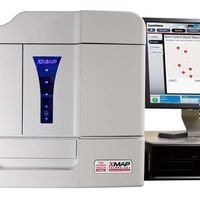
xMAP Technology
Color-codes microspheres are available into 500 distinct sets. Each bead set can be coated with a reagent specific to a particular bioassay, allowing the capture and detection of specific analytes from a sample. Inside the analyzer, a light source excites the internal dyes that identify each microsphere particle, and also any reporter dye captured during the assay. Many readings are made on each bead set, which further validates the results. Using this flexible, open-architecture design, xMAP Technology allows multiplexing of up to 500 unique bioassays within a single sample, cost-effectively, rapidly and precisely.
Applications
Various body fluids can be used for detection of biomarkers using the xMAP technology. An overview is posted below
- Supernatant
- Plasma/Serum
- Synovial fluid
- Middle ear effusions
- Humanized mouse models
- Ocular fluid
- Atherosclerotic plaques
- Cerebrospinal fluid
- Exhaled breath condensate
Available panel
| IL-1RA | MIF | Adiponectin | sPD-1 | |||
| IL-1a | LIF | Adipsin | FAS | |||
| IL-1b | OSM | Leptin | FAS-L | |||
| IL-2 | TSLP | Chemerin | LAIR-1 | |||
| IL-3 | LAP/TGF-1 | resistin | LAIR-2 | |||
| IL-4 | MIC-1/GFD15 | Omentin | IL-18BPa | |||
| IL-5 | CCL1/I-309 | PAI-1 | IL-1RI | |||
| IL-6 | CCL2/MCP-1 | RBP4 | IL-1RII | |||
| IL-7 | CCL3/MIP-1alpha | FABP4 | IL-1R4/ST-2 | |||
| IL-9 | CCL4/MIP-1beta | TPO | TNF-RI | |||
| IL-10 | CCL5/RANTES | SAA-1 | TNF-RII | |||
| IL-11 | CCL7/MCP-3 | G-CSF | sIL-2R | |||
| IL-12 p70 | CCL11/Eotaxin | M-CSF | sSCF-R | |||
| IL-13 | CCL13/MCP-4 | GM-CSF | galectin-3 | |||
| IL-15 | CC17/Tarc | SCF | galectin-9 | |||
| IL-16 | CCL18/PARC | HGF | P selectin | |||
| IL-17 | CCL19/MIP-3beta | EGF | E selectin | |||
| IL-18 | CCL20/mip3a | FGF basic | Cystatin C | |||
| IL-19 | CCL22/MDC | NGF | SLPI | |||
| IL-21 | CCL26/Eotaxin-3 | BDNF | Elastase | |||
| IL-22 | CCL27/C-TACK | VEGF | Elafin/Trappin2 | |||
| IL-23 p19 | CXCL4/PF4 | sICAM | ||||
| IL-25/17E | CXCL-5/ENA-78 | sVCAM | ||||
| IL-27 | CXCL8/IL-8 | sCD14 | ||||
| IL-29 | CXCL9/MIG | sCD163 | ||||
| IL-31 | CXCL10/IP-10 | MMP-8 | ||||
| IL-33 | CXCL11/I-TAC | MMP-9 | ||||
| IL-37 | CXCL13/BLC | S100A12/EN-RAGE | ||||
| TNFa | CXCL14/BRAK/MIP2g | TIMP-1 | ||||
| TNFb/LT-a | XCL-1 | TREM-1 | ||||
| IFNa | OPG | Cathepsin B | ||||
| IFNb | OPN | Cathepsin L | ||||
| IFNy | KIM-1/TIM-1 | Cathepsin S | ||||
| LIGHT |
Contact
Dr. Wilco de Jager
University Medical Center
Dept. of Pediatrics CMCI
KC01.069.0
Lundlaan 6
3484 EA Utrecht
The Netherlands
Phone +31 88 755 0808
Fax +31 88 755 3931